Getting away from the crowd may help you find bigger animals, but there are factors to consider.
We’ve probably all experienced crowded public land hunting where the bowhunters seemed to outnumber the game animals. If only we could get a little farther from the road and get away from the crowd!
But how far is far enough? There’s no easy answer to that question. It depends on each situation and your physical ability, the terrain and the gumption of other bowhunters.
In an ideal world, your efforts of walking farther would reward you with unpressured, trophy-sized game animals. But it doesn’t always work that way. In some areas, public parcels may simply not be big enough to get away from other motivated hunters. You’ve also got to consider your physical and mental abilities. Can you walk several miles in rugged terrain? And how far do you want to walk in the dark if you’ll be entering and exiting the field each day?
On an extended hunting trip, you can go farther, either packing all your gear for several miles, or setting up a spike camp well off the road, and then traveling light from there to hunt each day.
What modes of transportation do you have available? Will you be on foot? On horseback? On a raft? I once shot a moose in Alaska on a solo hunt. I was 19 miles from the road. I was traveling by canoe. This hunt would have never been possible if I’d had to hump all my gear and each moose quarter 19 miles on foot!
Terrain plays a factor as well. There’s no magic number, where you can say, “If you’re two miles off the road, you won’t see another hunter.” Often, if you can get across a physical barrier like a river or a mountain, you’ll leave other hunters behind. But that’s not always easy or possible. And you may discover other hunters are just as ambitious as you.
A buddy and I once got into some untapped moose shed hunting by crossing a river. He’s a whiz with maps and he had it all figured out. We had to pack in waders for a couple miles to the shallowest river crossing. Then after crossing, we left our waders behind to lighten the load before walking a few more miles to set up camp. On another similar shed hunt, we reached the narrowest crossing and then dropped a couple trees across the river to act as a bridge. On that trip we found a dozen moose shed in a couple hours.
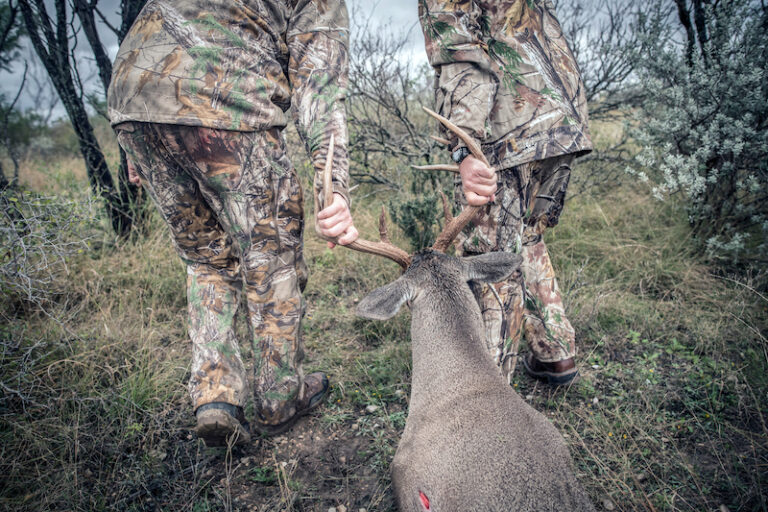
Consider other limiting factors. How much gear do you need to carry? And how do you physically get your animal back to your truck if your hunt is successful? Can you get it out before it spoils if the weather is warm? What’s your rescue plan in case of a serious injury? And you may even be restricted by cellphone reception. You may want to consider getting or renting a satellite phone if you’ll be way back in there, in case of an emergency.
Keep in mind, not everyone in your party may have the same physical ability. Be sure to accommodate other bowhunters in your group who may not be able to hike as far.
And remember, hiking farther isn’t always better. You just need to go where the animals want to be. I used to hunt a parcel of public land on the edge of the city limits. It seemed so obvious that I think a lot of people just assumed it was crowded and looked for a better spot. And sometimes those little out-of-the-way odd corners can get overlooked. There might be an odd little two-acre parcel that you wouldn’t consider hunting, but it might hold a surprising amount of game or even serve as a sanctuary from hunters on adjoining private land. It’s worth a look.